
Using images out of context is one thing. Using images that are clearly exploitative as part of your marketing is something else.
Bruce Gilden is a controversial figure in the world of photography, a description that he almost certainly relishes as the notion of being “edgy” helps sell his art. He is renowned for his intrusive, exploitative style, firing a flash in the faces of unsuspecting people as they walk down the street. I’ve argued previously that, as much as these photos document moments of life, each image is a depiction of Gilden’s ego. Legally, he’s entitled; morally, he is obnoxious — something that the art world seems to love.
Later portrait work also leaned into controversy; a regional arts organization in the UK naively commissioned Gilden to shoot a series of images that proved to be so exploitative that no local galleries would exhibit it. Fellow Magnum photographer Martin Parr described the work as “tough but true”; he’s right, but he also forgot to mention crass, exploitative, and entirely void of empathy. Given that Gilden is famed for having once boasted “I have no ethics,” he would probably agree.
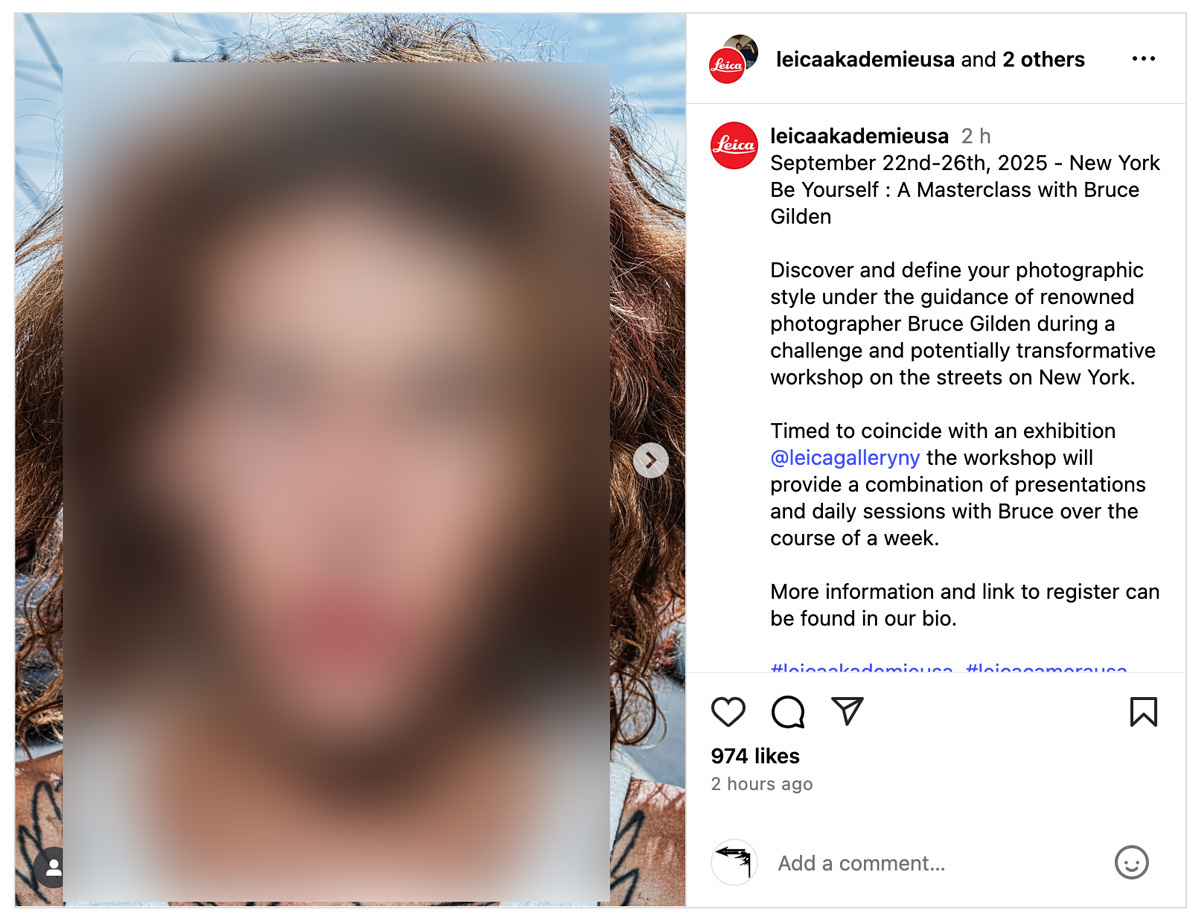
On social media last week, Leica marketed a masterclass with Bruce Gilden, using one of the photographer’s most notorious portraits to help sell the course. “Discover and define your photographic style,” reads the accompanying text, ignoring the fact that the image is of a vulnerable adult who was first exploited for art and profit and is now being used to sell a workshop that costs $2,000.
Exploiting Vulnerable People for Misery Porn
Philadelphia’s Kensington has built a reputation over the last couple of years, with one local media outlet describing it as the East Coast’s largest open-air drug market. As this article (paywall) notes, Kensington “is a failure of our health care system, our cities, and our drug enforcement policies on public display.” And for certain creators, it is also “a content farm, where they turn other people’s misery into engagement and profit.” To this day, there are livestreams of Kensington showing people suffering, with YouTube channels monetising voyeurism. If you wanted to photograph vulnerable adults clearly demonstrating diminished responsibility as part of an “art” project, this is exactly where you would go.
That, potentially, is what Bruce Gilden did back in 2023 in creating his portrait of Amber — the photograph that’s now being used to market his collaboration with Leica. Taking her portrait and parading it as art is exploitation; using her to sell a masterclass is disgraceful and Leica should be ashamed.
Art Should Challenge, But It Shouldn’t Exploit
Gilden’s portraits challenge viewers to confront uncomfortable aspects of modern society, but the style strips the subjects of their context and isolates them from their stories, presenting them as little more than surface. In discussing his portraits, Gilden explains that he "suffered emotionally, and it shows in these pictures,” but that’s not conveyed when these individuals are reduced to nothing more than an image. There’s no story, no depth, no empathy, and no humanity. And if that image is then selling a course that teaches you how to be equally exploitative as part of your search for clicks and validation, I’m not sure you can defend it.




I think the time of “ethical” street photography has long passed. Looking at backs, legs, and turned-away faces is just boring. Bruce will always stay controversial but relevant — the rest will fade away. To me, he’s gone far beyond photography; it feels more like an art performance than a street shooting routine.
Of course, you can keep safely shooting in hopes that the work will be interesting to look at in 50 years, but that path isn’t for everyone. For me, if ethics is the main concern, then street photography simply isn’t the right place. I thought about it — and walked away.
So ethics is not a concern if you're making art..?
I was speaking about the act of shooting as performance, akin to what the Abstract Expressionists did.
But you’re partly right. In art, this is often seen as part of the search for new forms of expression: the artist deliberately steps beyond familiar norms to shift the boundaries of perception and offer the viewer a different experience. That’s exactly what he’s doing.
Andy, Alvin is right… Ethics in art isn’t about playing safe or avoiding discomfort—it’s about intention and accountability. Gilden doesn’t exploit misery, personally he’s been there, his histwoycis well documented and I don’t need to recant it here; what Bruce does is confront us with what we’d rather not see. That confrontation is ethical because it forces recognition instead of erasure. These photos in particular are consensual, in some cases maybe the last photos of the people in question — made into icons, or illustrative mosaics. The work lays directly in the art world like few other photographers.
The history of art has always been bound to suffering—Goya, or say in photography Arbus, Goldin, D’Agata even the Ancient Greeks knew that beauty and horror live side by side. Ethics in art isn’t about denying that reality; it’s about how we frame it. To me Gilden doesn’t exploit misery, he forces us to face it. If you want to say it’s his ego, well he isn’t a photojournalist feigning objectivity. It’s subjective.
Your argument here seems more like click bait. It’s not a deep dive into who Bruce is as an artist or even a photographer. It’s short. A hit peice. You are expecting people to rally to diminish what he does, that’s old hat. To hate on Leica for being expensive and for a certain social class, also old and tired.
I question your ethics. Have you taken an ethics class in college? The history of art has always wrestled with suffering, but the real ethical lapse here isn’t Gilden’s—it’s in how you frame him.
To call his work exploitation reduces both the subjects’ autonomy (remember consensual photos) and the history of photography and art itself. Ethics means grappling with complexity, not flattening it for an easy hit-peice from a tech writer.
Please look deeper.
Hi Bill. Have you ever spent time working with vulnerable adults? Do you understand what it means for someone to have diminished responsibility as a result of abuse, disability, or addiction?
Susan Sontag said, ‘Photographs cannot create a moral position, but they can reinforce one.’ Gilden’s faces do that—if you can’t handle them, maybe the problem isn’t the photography. It’s an ideological perspective. Art isn’t a social science. It’s a reflection of society itself in 2025.
These photos confront us with a social vulnerability we’d rather not see, or clearly has impacted you enough to write this article. The real question isn’t whether he understands diminished responsibility—it’s whether you can face it head on. Authorship at some point is moot.
These images exist, Bruce has authority and years as a workshop teacher—he’s done this with Leica before, as well as MAGNUM. His skill is not in question.
The class is about finding your own perspective in work, I’d rather it be with someone who has made some notable work than someone who is a paid ambassador for the brand. If you’ve seen his other work you may get a better idea of his purview. Hati, Go, Cherry Blossoms, the work with foreclosures in Detroit. Political campaigns. Fashion spreads with Gucci…
He is clearly not only qualified, but a major photographic voice in many areas.
But do what you do. Just maybe go a little deeper.
Bil Brown preys on vulnerable barely legal adults, he does not hide the fact that he frequents BDSM clubs for his „work“ but instead of documenting an underground scene like he claims, he only takes photos of young women performing acts of submission and self-harm and does not even get their names, (this is a fact, he has been asked before about the name of a subject and he dismissed it by just calling her a BDSM performer, this can be found on his instagram comment section) let alone knowledge about their mental state and have their photo posted for the world to see - uncensored on a platform where minors can be exposed to it.
Bil, that was a lot of words that didn't respond to either of my questions.
You said somewhere above that artists don't need our permission. It's that sort of hubris and sense of entitlement that led to Harvey getting booted out of Magnum.
You accidentally replied to the wrong person, but thanks for pointing out the method in this guy’s debating style. Gish gallop with politician-level dodging of direct questions. It’s really annoying, and he’s disrupting what could’ve been a more thoughtful conversation. Probably his aim I’d reckon.
His suggestion that someone “on skid row” who might be high as balls is capable of affirmative consent confirms that he’s got no idea what he’s talking about, is arguing in bad faith, or both.
I wish these types would’ve gotten into macro photography or something instead. If they aren’t going to do anything to help solve real problems at least they wouldn’t get in the way since they’d be off taking close up photos of ants.
Bil Brown hasn’t used enough words and inserted random stories to deflect from your questions that he published a rambling blog (bilbrown.substack.com) about your article and naming you - he also named me and wrote a whole section about me, including my name, even tho im not a public person and only chose to comment here with this audience and can delete if i choose so. Bil singling out a female model from the many commenters critiquing him and calling me a troll is malicious and only proving my points that he is policing others speech and does not respect consent or protecting vulnerable people.
Andy, equating David Alan Harvey’s institutional resignation with Bruce Gilden’s confrontational photography is a basic category error. Gilden isn’t exploiting anyone—he’s taking pictures. His subjects decide how they show up; their agency is intact. Confrontation ≠ cruelty.
That is simply, what bothers me about your clickbait title and short article without any counter. It reeks of "cancel him because I don't agree with him, and go ahead and cancel Leica too."
“Privilege” is a cheap shot—I offer an informed critique, the counter to your bias, not even close to entitlement.
You still haven't answered my questions. Why?
I understand vulnerable adults, I understand their diminished responsibility, from abuse, disability and drug use. These are from my series MY MOTHER DEMONOLOGY. This is MY FAMILY. My younger brother who has been in a wheelchair his entire adult life and is currently in a nursing home. My deceased brother, who was exploited by his ex wife and slowly murdered by neglect. My sister who is/was addicted to meth.
You don't know me. You don't know Bruce's story. Ask. I would love to have this platform ask him for an interview. See why and what he does. Look deeper into why these photographers you so despise do what they do.
Look, I'm not going to get into whether you are a good writer or not or a good photographer. I am going to assume you are at least trying to be a good human... but this is not the way to do it.
You didn't comment on any of the things I brought up that were important either. Dismissing the documented erasure of marginalized communities as “laughable” isn’t critique — it’s complicity. Coming at things from a purely social justice guidebook, without at least trying to figure out something with dedicated research is inauthentic. And let’s be clear: criticizing an artist like Bruce Gilden without engaging his background is the same move. I show you this and you can judge (if you are an asshole), but I am sure you will find some sort of way to absolve.
Gilden didn’t come from privilege — he came up working-class in Brooklyn, the son of a bookmaker, drawn to the street because it was his lived reality. His confrontational portraits are not voyeurism from above; not from a Yale MFA in Anti-Colonialist rhetoric (which btw I follow and integrate into my own practice but as example)–they’re rooted in street the grit, tension, and humanity he grew up inside of.
Bruce Gilden is from the streets, He shoots the streets. His aesthetic is the streets. Pretending he has some sort of privileged mean sense of the people he photographs is complete and utter bullshit—it erases the very social context that gave his work its validity. It's disingenuous at BEST and if I wouldn't know better (with the Harvey reference you threw at me), I would think it was an actual attempt at social assassination... which is of course, slander.
If you want to critique an artist, start with facts. Anything else is bad faith. Are the images technically and aesthetically hold value? (yes), can you clearly here the thesis of the artist in the work? (yes), is it work anyone else contemporary to the artist is doing? (maybe Martin Parr). For better or worse, Bruce Gilden is part of photography's canon and isn't going away. That is why the workshop is happening, that and (shocker) he shoots with and has shot with a Leica.
And if you say I am exploiting my family by posting these photos from my mother's wake a few months before the pandemic, without finding out the context of these – then you will simply be proving you have zero aesthetic authority at all.... something I would expect more from the Senior Writer for FStoppers.
Also, Andy. You have two people in this thread who have produced for or worked directly with Bruce Gilden giving you an exact picture that is consistent on how he works the streets for these portraits. You have had people talk about his work at the Democratic and Republican Conventions, and Trump Rallies for Vanity Fair, his Farmboy and Farmgirl series at State Fairs. These people aren't marginalized, they are what society would consider :well adjusted". If your only critique is when he goes to Kensington or the like tell me this, how would you like to see him do it?
I don't see anything on your website that offers you know how to address these subjects at all. I'm curious what kind of person do you think can go into those environments and actually get any photos at all? Or do you think they should be coordinated with officials that are often complicit with wanting to make a particular local or government agency look good, or have their own agenda?
You know photography is a subjective art, right? You write for a photography blog I would hope that is something you know. You have critique but I am not sure you are giving any particular solutions here.
Last thing, one of my first influences was the late Mary Ellen Mark who grabbed me when I was just starting out as a photographer. I was trying to make ends meet for my family and shooting an event she was at. She grabbed my arm and told me I was "doing it right". I broke down and told her all this "struggle" I was having with local "professional" photographers telling people that would pay me not to work with me because I didn't shoot right or I didn't have a studio at the time or whatever.
She stopped me, and said, "You know, I have had my fair share of criticism in my career. I think as photographers we have to just do the thing that we do when we take pictures: The reason they are so mad at you is, you EXPOSE them."
Ad hominems only undermine your position.
If you know about diminished responsibility, then you will know that it's very likely that a homeless drug addict is not in a position to make a decision. Everything else you argue is a post hoc attempt at justification. Gilden sought out a victim of society in order to present them in the worst possible light during what is probably the worst period of their life, at a time when their sense of self and ability to decide was almost certainly compromised. If Gilden cared, he wouldn't use the image for advertising.
Look at the power relations. Who is in control? Who benefits? Who makes money? Who builds their reputation?
The idea that charities working with vulnerable people are trying to hide them is delusional.
He sought them out because no one else is. He put them on a pedestal because no one else will. He gave them agency in a world that gives them none. Disability becomes visibility. These images a re beautiful, in some of the best galleries in the world. Seen by the elite they wouldn’t give them a second look in person.
Have you considered they want to be seen? Many times he has said they think the images are beautiful. And he does often interview them. Have you seen the magnum website? Have you done your research?
It is fact. By design. Come to Skid Row in Los Angeles and see the “Housekeeping Routine” every Friday and Tuesday. It’s sheep herding. You likely wouldn’t. It’s pathetic. It’s not humane. We have a government that outlaws homelessness without giving a solution. Both liberal and conservative voices aren’t doing anything except ghettoizing and giving big pharma more agency and voice than the people in dire circumstances.
It’s his work. What else is he going to use? He’s an artist, but not Richard Prince. He’s not rich, he’s in fact spending his own money to make these documents that will out last him.
It’s not ad hominem when it’s true, Andy. I can’t take your criticism with any sort of authority when you clearly aren’t doing the work. When your journalism is Op Ed for a few paragraphs without a deeper dive. You say my points are delusional without offering proof. I offer actual events, things I have seen with my own eyes. I have documented how he shoots these portraits. I have data. You don’t.
All you have is opinion, and I am countering it.
Do these look like photographers who don’t care? One image is when we literally saved this man’s life. The LAFD is the busiest in the US saving people because the city and orgs can’t do anything, California has the largest unhoused problem in the country.
Don’t tell me bringing this to light does nothing. That it is power dynamic. What power? Bruce Gilden isn’t Elon Musk.
"...at a time when their sense of self and ability to decide was almost certainly compromised. If Gilden cared, he wouldn't use the image for advertising."
"Look at the power relations. Who is in control? Who benefits? Who makes money? Who builds their reputation?"
If you're not going to address those two points, there's no point continuing this conversation.
I have answered but I will make it clear for you.
https://petapixel.com/2024/09/23/bruce-gilden-says-hell-be-broke-in-a-year/
He’s spending his own money to make these photos.
An artist has a right to sell thier work. These aren’t snapshots they are considered. Maybe you done like artists having thier own agency.
Bruce already had a reputation before he started doing the Face portraits in the 2010s. He didn’t have to do it. He was already magnum for over a decade. This is a project very personal to him.
By talking about control issues, you aren’t edging on the entire idea taking a photograph in general. I suggest you look at some deeper discussions in this Arena critical areas I mean even older examples like Barthes and Sontag may talk about control but they admit the photographer is at the end of the day just taking a photo.
Sontag says in On Phorography, “photographing is essentially an act of non-intervention.”
That phrase — “an act of non-intervention” — is Sontag saying outright: the photographer is powerless in the moment. They can witness, frame, record, but they cannot alter or control the subject’s lived reality.
Did you not see this photo right here above, where we intervened and actually got this man help instead of just taking a fucking photograph? That’s me and Bruce.
I think you’re just trying to deposit your thesis and not really going any further into looking at what your thesis actually means.
You've not addressed any of those questions. The power dynamic doesn't change just because Gilden is broke. It's systemic. Hierarchical. Patriarchal. Social. Either you don't understand how the camera can be used as a predatory tool, or you do understand it and can't address it because it challenges your worldview.
You argue that I need to dig deeper and understand the context in which the work is made, and yet the image is used completely devoid of context to sell a product. You can continue with endless words about Gilden and how he works and how he cares but this contradiction makes it all meaningless.
A homeless drug addict who’s on the record as resorting to prostitution to pay for her next hit cannot give informed consent. If you argue that she can, you are a liar. If you say that it doesn’t matter, then you are exploiting her. If you're then saying that exploiting her is ok because it's art, then there's no point discussing this any further.
“There's no standard way of approaching a story. We have to evoke a situation, a truth. This is the poetry of life's reality"
- Henri Cartier-Bresson
From the MAGNUM website. The documentary tradition is part of photography. You may have your opinion. A photographer has a right to use their work to promote themselves. No one is being held down to take the class. $400 a day ($2000 total) is fair — barely $50/hour— Standard. He is not teaching “human misery” that is your promotion of your article that has no mention of the documentary tradition he comes from — Lissette Model, W Eugene Smith, William Klein, Mary Ellen Mark, Japanese photographers and Magnum themselves.
Even if someone is impaired, their image can still carry dignity, truth, or resistance. I see Bruce’s images as that. They are staring directly at th camera, lit well, everything is seen as it is in pure hyper realism. The images confront us.
Many people living on the street want to be seen, remembered, or acknowledged. This I know, I’ve been there. The camera can give them presence in a world that often erases them.
As Gordon Parks said: “I chose my camera as a weapon against all the things I dislike about America.” Consent is compromised precisely because of systemic oppression—and photography is one way to fight that oppression. w Eugene Smiths MINIMATA is a perfect example, as is Antonie D’Agata. The subject’s agency is already fractured—by drugs, by society, by exclusion. The camera doesn’t “steal” it; it mirrors it. It’s a form of solidarity. The person already lives without agency, they have been out there by circumstances. The context is apparent.
The ethical core is not: “Did they agree?” but “Did I expose the violence of their condition honestly, with myself implicated?” You validate his work by saying he shouldn’t use it to promote… his authors on the very thing he is photographing.
We will not see eye to eye, because your ideology around aesthetics and photography differ from mine. These are both irreconcilable truths. If you are right, then the image cannot exist. It I am right then you cannot practice safe distance, controlled output and your version of ethics.
I agree to disagree.
I don't think you're engaging honestly in this conversation so there's no point continuing.
Honestly, Andy? You keep insisting I’m not “engaging honestly,” but your own argument strips all context from the image, the author, and the history of documentary photography. This isn’t an ad selling soap. It’s a workshop tied to a gallery show by a Magnum photographer with Guggenheim, NEA, and international recognition.
In your article you reduce Bruce Gilden to a YouTuber “monetizing voyeurism,” while ignoring both his authorship and his right (legally, artistically, institutionally) to use his own work. Zero context.
I’ve offered first-hand accounts of how he works, evidence of systemic violence by the state in Echo Park, Skid Row and I’m sure Kensington, and the role of nonprofits siphoning funds while hundreds of thousands remain unhoused. You dismiss it as “delusional,” gaslight those who’ve actually been there, seen it and the way Bruce works and comes to an area like this to show the faces effected by this oppression because he’s been there and he has some clout. You wave it away with a one-liner about dishonesty.
That’s not critique, a form of erasing the situation and saying, “well he’s making money” on his own work. It’s not sitting on some hard drive or blog post, it’s engaging with the world.
Your position isn’t new — it echoes the same neoliberal sanitization that tried to neuter Salgado, D’Agata, McCurry (in this very thread thanks Tony Northrop) and every documentary artist who shows reality unvarnished. If you can’t see the difference between exploitation and authorship, between silencing and witnessing, then maybe you’re not critiquing Bruce Gilden or photography at all — you’re just attacking it.
If you done think I’m engaging honestly let’s hear it from Bruce. These were posted from his IG a few years ago.
“ As my assistant and I were driving around Overtown, Miami, we ran into Shirley, a beautiful black woman with a blonde wig.
Shirley is an 81-year old lifetime resident of the neighborhood and she told me that when she was a child there was a sign by the Venetian Causeway that read:
"No Niggers, Dogs, Jews." (Bruce is Jewish, btw)
“ Shirley's friend, a man in his mid-fifties, told me that when he was little, on his way to school in Miami Beach, he would run into a little old Jewish man, always dressed to the nines, and accompanied by an entourage.
The old man would always invite him to have breakfast with him and the little boy would always refuse. When he told me that the old man was Meyer Lansky, the famous Jewish gangster, I couldn't understand how he could refuse an offer like that!
“ Someone told me that Texas, one of the prostitutes that I had photographed, recently died from a heroin overdose and I remember our conversation in 2015. We had talked about her lifestyle and she said that she enjoyed it and that she would stop when she didn't anymore...
“ My assistant and I were driving around a deserted street when we saw a drug addict riding her bicycle. All of a sudden she crashed into the curb, went flying through the air, and hit the sidewalk. "I broke my leg!" she screamed, and, in the next breath, "Where's my money! I had it in my hands!" She explained to the two people who came to help that this was the third time that day that she'd fallen off her bike. "Don't you want to go to the hospital?" one of them asked. "No, I don't want to go to jai - I don't want to go to the hospital!" Then she got up- obviously her leg wasn't broken. She had her money, and she was off to cop.
“I had seen this woman with sunglasses walking in an alleyway and as she came out, she said to me, "Don't you remember me?" And then she took her sunglasses off, I said, "Trish?" She had aged so much in fourteen months. I wanted to do an interview with her and we scheduled a time for the next day but she never showed up.”
The subsequent photos are well known. What does this tell you about Bruce’s interaction?
Andy, Bruce’s photos aren’t taken in isolation. He engages, remembers names, voices, and stories—Shirley recalling racist signs, “Texas” reflecting before her overdose, Trish returning aged and changed. That’s not extraction, that’s witness. If you miss that, you’re not looking at the work, you’re looking past it to your own ideological pretense.
This is what I have been pointing out consistently in this thread and I think you are deaf to it. You aren’t the only one… so thank you, thank you for activating me to the further discussion here. Beyond Bruce Gilden and into the furthering of honest street and documentary work that isn’t some orthodox idea of how the work is seen, shown or interpreted.
Andy, My god who do you think you are to be concern trolling people you don't know? You're doing that thing, we can see it. How about this...
You are a parkour photographer. Let that sink in. Scumbag central. Parkour is a shitty douche lord irresponsible culture that is ground zero for Insta trash influencer slop content.
Have you never heard the critiques? Do you not know the hate that you and the people like you stir up in society? Do you lack all self awareness? You have no ground to stand on just questioning people as if there is any answer that would satisfy you. As if it even matters. As if YOU are the arbiter of ethics. As if we owe you an answer. You're a bully. You are deliberately excluding the qualified experience of others that goes against your woke scold invented narrative. Your entire article screams this and your interaction afterward is nuts.
You are not fit to judge or question people unilaterally on this issue. Your point of view in this article is devoid of reason, consideration of facts, and just purely written from a preset agenda to attack what you perceive as "power." Which is laughable because if you did any research at all you would know that Gilden is neither powerful nor rich. Nor does he use whatever power he may seem to have. He's an artist who has spent his life exorcising a voice. In case you aren't aware (rhetorical, you clearly aren't) THAT is what we are supposed to be doing!
You are virtue signaling in the worst way. From a position devoid of virtue.
Look without digressing in the name calling, there are differences in photographic practice. There are differences and experiences of different types of photographers just like that there are different experiences and different types of people that drive cars for instance.
You have a race driver that has a controlled environment, has cruise to make sure that his vehicles up to snuff and the the operator of that vehicle has to have a specific skill set. They have sponsors they have other things to make sure that they stay on track literally.
Then you have a commercial truck driver that has to go through all sorts of different communities all across their route, which can in Europe mean going to different countries and being in different situations and being on the road alone and having to deal with different types of people, they have to be self-sufficient Often times able to handle themselves in a tight situation. They have to be somewhat personable, but at the same time very very self-reliant and alone for long periods of time.
I think some someone that has to deal with clients that takes the work that they are doing seriously to be able to sell an image to a person, or does architectural photography, for instance, or even just photography for themselves it’s very different than a documentary Photographer that isn’t a journalist that is creating a body of work based on their own experiences and the way that they see the world. You can’t relate to two things. Both things do not have the same ethical standards. Both things do not have the same social standards or even same responsibility.
No, I could go too deeply what I feel about our journalists and their relationships with editorial control for instance. And how an agency like MAGNUM was created specifically to return the authorial control back to the photographers themselves and the images that could be sold to multiple platforms at once., become part of an archive. Now this creates a specific type of lone individual. Cartier-Bresson going to photograph the death of Gandhi for instance all alone getting the shots, not knowing where they were going to be sold to, but he knew that what he was doing was important. He was able to focus on the aesthetics as was his surrealist background. No one talks about his politics, really. That he worked for the French resistance and was a first AD for communist propaganda films during World War II. That he was actually captured and escaped from the Germans. And by the time the 60s rolled around and MAGNUM started becoming more partially based out of pure survival, he decided to retire.
Gilden is almost 80. You look at other photographers in his generation.— Diado Moriyama, Nobiyoshi Araki in Japan, maybe Josef Koudelka (who Bruce identifies with as someone who changes their work with the times and And keeps doing interesting things). Many of these photographers have a solo vision based on their own ideas of what photography is in the influence of those who became photographers before them. This is an interesting art form isn’t it? It’s only 180 years old and it’s not exactly the same as any other art form not even its closest relative cinema.
I think to protect the subjects in our photos is of course, important. But we aren’t taking away their homes or feeding them Poison by taking a picture. I think we forget that. It’s an image and the best images in my opinion are those that are intimate and have close contact instead of editorial distance. And photographers like Gilden have approved time and time again that they can do that in an instant mirroring a moment of time that they see or their camera sees.
And although your discussion of ethics has its place, I don’t think it has the same rules as other forms of ethics.
One of my friends and students is a photographer and a scientist. Specifically his a scientist that is trained as a philosopher of ethics and has worked with large corporations and told them that thier practices for AI are unethical. When I asked him about the subject of Bruce Gilden, his response was simply this: is he hurting anyone? Is he taking away their means of making a living? No that’s already been done by the state and corporate concerns. The only thing that he can think of is their privacy is he taking away their privacy? Is he taking away their agency? Can we even do this by taking a photo? And then we have to ask if in taking their photo does it add to the cultural dialogue around their condition and does that supersede their individual agency? I think it does. And I think that an artist not a journalist has a different responsibility.
Let me ask you one last question: do you feel photography is subjective or is it entirely objective? If it is objective, maybe this form of discussion about exploitation exists if it is subjective, you may be exploiting the author, as well as drawing attention to the subject without referencing the conditions that made them a subject in the first place.
This is just food for thought.
This guy Bil Browns frantic need to reply to anyone offering even mild criticism is telling. He’s not just a defensive Leica fanboy, he’s a Leica salesman, a small detail he conveniently omits.
Bil Brown is not not an active photographer, unless you count hanging around BDSM clubs snapping one-handed shots of women in bondage. He’ll occasionally free the other hand, not for composition, but to smear the last oily strand of hair off the lens before going home to draft yet another sanctimonious essay for his Instagram about “consent” and “empowering women“ with the sole purpose to virtue signal and masquerade his pervy intentions for high art.
Just one look at his IG proves this.
I've done portraits of people in difficult circumstances (portraits of unhoused people, group and baby pics of whole families living in emergency shelters but wanting to have a nice family pic to send out in holiday greetings or just have as a nice memory).
In every case I use the lyrics of a Don MacLean song as my ethical North Star: "Weathered faces lined in pain are soothed beneath the artist's loving hand"
Be the artist's loving hand, or go away.
In other words, if you are doing social commentary but not doing it with sincere empathy and love - STOP.
Engage with the people you are photographing, listen to their stories, even if they recount hardships you can't help with. They might just need someone to listen.
Get involved in whatever constructive way you can to enhance their dignity and respect their agency.
Be the "artists' loving hand."
Agreed. It’s this type of thing - which hides behind the protective embrace of “art” - that blurs the line between reality and The Hunger Games. Other people’s suffering just a resource to be exploited to feed one’s bank balance and ego.
Back when human art was cave paintings and petroglyphs, people like Bruce here would’ve been kicked out of the group and left for the wolves.
Edit:
This comment section went crazy. (And omg this one guy is off his meds or something, good grief.) [It’s a couple days later now, I think he’s finally burned himself out. Guy needs to remember to take his lithium, he’s low key unhinged.]
And the core part of this issue gets conveniently glossed over.
I too walk among the homeless, dodging used syringes, feeling the crushing weight of their misery, hearing their stories.
Rather than a camera system and lighting that costs more than a small automobile, what I carry are dozens of sandwiches and bottles of water. I don’t have photography assistants helping me, just fellow volunteers.
People who profit in any material way from “art” that uses society’s most vulnerable (consenting or not) as its primary resource are ethical failures. Bruce isn’t pursuing a mission of ending homelessness. He’s not trying to materially help these people. He’s using the images he takes of them to farm clout. To fill galleries, sell workshops, to inflate his coffers and bolster his reputation, his legacy. If these people didn’t exist for him to exploit then he wouldn’t be making any money. The money and adoration relies on his subjects’ misery - it’s the resource he needs for his “art” to exist.
He goes on his merry way after he’s done with them, the value their existence created for him stays out of their reach. His “art” doesn’t do a lick of good to end their strife or to move the needle on homelessness. It doesn’t change society’s values. He’s a MAGNUM photographer after all: most people haven’t heard of him and will never see his photos. Those that do, whether snacking on canapés in some gallery or arguing on Fstoppers, are proof positive to the fact that his “art” is about his ego, not about his subjects:
All the oxygen in the room gets sucked out talking about Bruce. Zero breath is spent talking about how the much more important issue of homelessness and how we as individuals can seek to help prevent our fellow humans from falling into its abyss.
Regardless of what side you’re on, myself included, you’re arguing from your place of comfort and security in the Capitol. Whatever cognitive dissonance gets you through the day is your business, but don’t fool yourself.
Some misconceptions in the above:
"People who profit in any material way from “art” that uses society’s most vulnerable (consenting or not) as its primary resource are ethical failures. Bruce isn’t pursuing a mission of ending homelessness."
Documenting it, publishing it and more is actually doing more than talking about it on a internet forum.
"He’s not trying to materially help these people."
I have seen him give them money or buy them water or a sandwich.
"He’s using the images he takes of them to farm clout."
He had clout from his other work.
To fill galleries, sell workshops, to inflate his coffers and bolster his reputation, his legacy."
Hs galleries are already filled, he spends his money to take these photos.
"If these people didn’t exist for him to exploit then he wouldn’t be making any money."
He spends his money to take these photos and if they didn't exist he would take other photos , and does. See Vanity Fair, GUCCI, and there various fashion magazines he shoots for of late.
"The money and adoration relies on his subjects’ misery - it’s the resource he needs for his “art” to exist."
This is just pure fantasy.
"He goes on his merry way after he’s done with them"
He actually goes back and looks for the same subjects again, the ones he has become friends with. Across the country.
Ethical values are determined by social class and the real problem is that many wealthy people have a prejudice that poverty is a sign of moral degeneracy. A working class person might view Gilden's photography as exploitation but an upper class person could easily see it as a neutral document of unethical behavior. Photography that mocks the appearance and daily routines of the lower classes is a popular theme in reportage. Leica buyers see it as "edgy" because its harsh realism emphasizes circumstances that wealthy people find disgusting. We shouldn't be surprised that the type of customer that can afford a $15000 lens and a $10,000 camera body might not have much sympathy for the poor. I'm not against wealthy people buying Leica cameras but viewing preferences can reveal contempt for those that they see as inferior. There are amazing Leica photographers like Bresson that had a neutral eye for design and his photos never seemed to be insulting of poverty.
Nevertheless, Bresson came from a very wealthy family and never thought about money. That’s why he was one of the few photographers who shot a huge number of frames without worrying about the cost of film.
McCurry still uses Sharbat Gula ("The Afghan Girl") to market his masterclass despite the fact that she didn't want the picture taken and it resulted in her being forced to leave her home country twice: https://mastersof.photography/steve-mccurry/
Have you tried therapy for this obsession?
Northrup is still contriving new ways to slander Steve McCurry.
No. This is just another episode of beating an old horse and my comment wasn't just a sarcastic quip. It is uncomfortable to see someone go down this road so repeatedly, hard, and obsessively. I believe this individual should seek help.
Thanks for the backstory on McCurry and it reminds me of how Dorothea Lange's children were in foster care when she photographed "Migrant Mother."
Unfortunately, Northrup's take on McCurry is a jumble of sloppiness. It is weird how years of YouTube success hasn't quelled an apparent obsession with taking down McCurry. I'm guessing it's driven by jealousy and a dedication to producing click-bait.
I don't know Tony and can't speak for his motives but McCurry's blatantly obvious "Orientalism" seems appropriate to discuss when the topic is exploitation.
Offer your own masterclass. Maybe you can teach McCurry how to make correct and proper photographs?
There's nothing "master" about a masterclass. Photographers that are stuck trying to make money from workshops are either nobodies or has-beens.
Interesting, but do you think McCurry created his photo in such an arrogant, rude and intrusive manner?
Was his intention not to document to show the world suffering at a particular moment in history, rather than looking selfishly to create a piece of shocking "art" to serve his own interests?
While Mr. McCurry may not have operated in the same manner as this article’s subject, I would suggest that intention doesn’t trump consent.
If it’s true that there was a young girl and she didn’t want her picture taken, then the taking of the photo in the moment is a violation of consent. Regardless of how it would affect her life in the future or how the person she would become would contextualize it.
I obviously wasn’t there. But if it’s credibly documented that she didn’t want to participate, well… no means no. And in its own way that lack of consent is understood as violence, especially given the dynamics involved. In that context, taking the photo regardless would indeed have been to serve his own interests, no?
You make a good point.
In the past, the term ‘monstering’, often applied to celebrities in the public gaze. Some (not all) street photographers base their practices on monstering poor people who cannot protect themselves. We used to call this ‘punching down’. It’s been described, with some justification, as a form of violence.
I agree; any form of street photography can be seen as a kind of violence.
I’ve always tried to find the line. Photographing a defenseless homeless person is unethical. But what about secretly photographing someone eating ice cream? Is that ethical? Or someone who has fallen, or is falling? Where is the line between what is ethical to photograph on the street and what is not? And why do street photographers prefer to remain unseen (in other words, to hide)? I haven’t found that line for myself.
Bruce Gilden is a self-centred nasty rude piece of work who lacks empathy. He gives street photography a bad name. I've witnessed a few street photographers copy him, rushing up to someone and sticking a flash and camera in their face, and often causing distress. Calling this "art" is a pathetic excuse, you're still a low-life.
Leica—specifically Leica USA—have made a few ill-advised moves with their marketing of late. I find this surprising.
Bruce has been doing workshops with Leica Akadamie for years if not decades. Just because the Internet decided to focus on this one doesn’t mean that it is a marketing issue. What it means is, the community has decided to turn away from what A powerful, much imitated, contemporary photographer has done.
I think workshops like these with real artists, that are doing gallery quality work is much more interesting than one of the “ how to use your camera” workshops that are the normal faire.
I applaud Leica USA and Leica Akadamie for doing something with someone that actually pulls someone away from the camera itself and into what it is that someone does with it. Otherwise we’re all just taking photos that anyone could take with a smart phone and we’re not actually trying to work on the things that move this art forward.
Regarding people imitating him, that's the problem. I've seen photographers do just that, and it's not pleasant. You state in a post below that his work is consensual? Well it doesn't look like it from what I've seen, and those who imitate him didn't get that memo.
You state below "you can’t say that the images aren’t excellent work."
That's like stating you can't say foie gras doesn't taste great. It does taste great, but how it was made is bloody barbaric and wrong!
How a brand markets their products builds their brand reputation. Leica being associated with Gilden is obviously upsetting people who don't want to be associated with a brand that is basically saying it's OK to be arrogant and rude for the sake of art.
Do Leica ignore those potential customers who are put off from buying their cameras and lenses because of this association? Maybe. It's certainly a question I would be raising at the next Leica marketing strategy meeting.
I appreciate your enthusiasm, except for the fact it is totally wrong.
For the Face Portraits of which this article is questioning: He asks for these portraits. The subject stands for them and agrees. They look at the portrait. He gives them sometimes a Polaroid or a little cash. Tell them who he is and why he is taking the portrait. They agree to the terms. Often he records a conversation with their story.
How else would you describe consensual?
Also, far as I can tell the workshop isn’t so people will shoot like him (no one can), it’s to find your own voice and vision. Somewhere in my MFA years back I got this maxim, “you cannot learn an art form except from someone who they themselves have created a notable work of art.” That doesn’t mean you have to like it, but clearly Bruce is notable enough that you know who he is, no? You don't like his take—there are plenty of workshops out there about how to shoot a flower or something. Matt Stuart is pretty good at shooting leaves. He often has workshops. If you want to learn how to troll great photographers ask Tony Northrop. There are many options.
Also, as for Leica… Leica has the largest Gallery system for photography in the world. Leica has the most inclusive and consistent photographic academy in the world. LEICA maintains a museum for photography, supports multiple new and established photographic artists (some who don’t even shoot Leica). Fuji doesn’t do that. Neither does Nikon. Canon couldn’t be bothered. Sony is just trying to sell cameras. LEICA is a cultural force.
As for why they are expensive: it’s a small company. The majority of their camera systems are made by hand. The optics are legendary. The craftsmanship is unmatched not even Hassleblad has the same quality. They’re the last camera company that is a small company that is owned by anyone in either the Europe or the United States. All other companies are Asian owned.
As for the price of the workshop: If you go onto the MAGNUM website, you see workshops that are $2000 plus consistently. MAGNUM isn’t selling a camera. This is just the price of a workshop with someone that is done as much as Bruce Gilden has done. Bruce Gilden has worked in fashion. Bruce Gilden is in magazines, the New York Times. Bruce Gilden has been a photographer for 40 years and has been consistent in their work.
What you were saying about Bruce’s aggressiveness, etc. I can tell you clearly, but that is not the case. From someone that has been with them on the streets. Seeing how they react to people. Seen the joy in which people react to them.
This is just some sort of illusion or delusion in your mind.
I think you should really think about it. And if you don’t, that’s fine I don’t really care. But don’t say things that are completely untrue with no foundation in anything but your opinion.
Wow, you're as arrogant as your buddy Gilden.
I think I can re-sue what you wrote to end my post:
"This is just some sort of illusion or delusion in your mind.
I think you should really think about it. And if you don’t, that’s fine I don’t really care. But don’t say things that are completely untrue with no foundation in anything but your opinion."